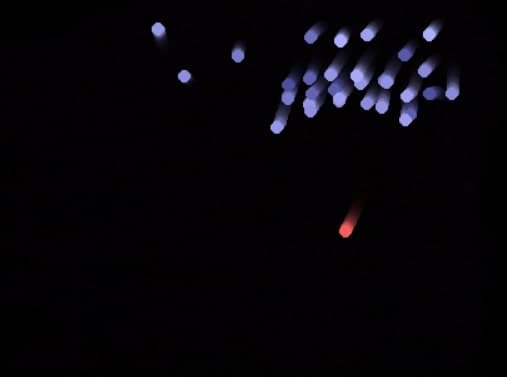
Overview
This project is a real-time simulation of flocking behavior, implementing Craig Reynolds' Boids algorithm to model the emergent movement patterns of fish schools and bird flocks. Individual agents follow simple local rules, yet the collective behavior that emerges is strikingly lifelike.
Motivation
Flocking is one of the most elegant examples of emergence in nature — complex, coordinated group behavior arising from simple individual rules. I wanted to implement this myself to explore how minimal rule sets can produce rich, organic-looking motion, and to build an intuitive understanding of agent-based simulation.
The Boids Algorithm
Each agent (boid) follows three fundamental rules:
Separation
Boids steer away from neighbors that get too close, preventing collisions and maintaining personal space.
Alignment
Boids adjust their heading to match the average direction of nearby flock members, creating coordinated movement.
Cohesion
Boids steer toward the average position of their neighbors, keeping the flock together as a group.
These three rules, applied simultaneously with tunable weights, produce remarkably realistic flocking behavior.
Technical Implementation
- Language: Python with real-time visualization
- Spatial Optimization: Efficient neighbor lookups to maintain performance with hundreds of agents
- Parameter Tuning: Adjustable weights for separation, alignment, and cohesion forces
- Boundary Handling: Agents wrap around or reflect off screen edges depending on configuration
Emergent Behaviors
With the right parameter tuning, several natural-looking phenomena emerge:
- Flock splitting and merging as groups encounter obstacles or each other
- Swirling vortex patterns when cohesion is strong relative to alignment
- Lane formation in confined spaces as agents self-organize into streams
- Predator avoidance when an external threat force is introduced
Challenges
Performance optimization was the main challenge. Naively checking every boid against every other boid gives O(n^2) complexity, which becomes prohibitive with large flocks. Implementing spatial partitioning reduced neighbor queries to near-constant time and allowed simulations with hundreds of agents at smooth frame rates.
What I Learned
This project was a powerful lesson in emergence and complex systems. It demonstrated how simple, local rules can produce behavior that appears intelligent and coordinated at the macro level — a principle that extends far beyond graphics into fields like robotics, economics, and artificial life.